




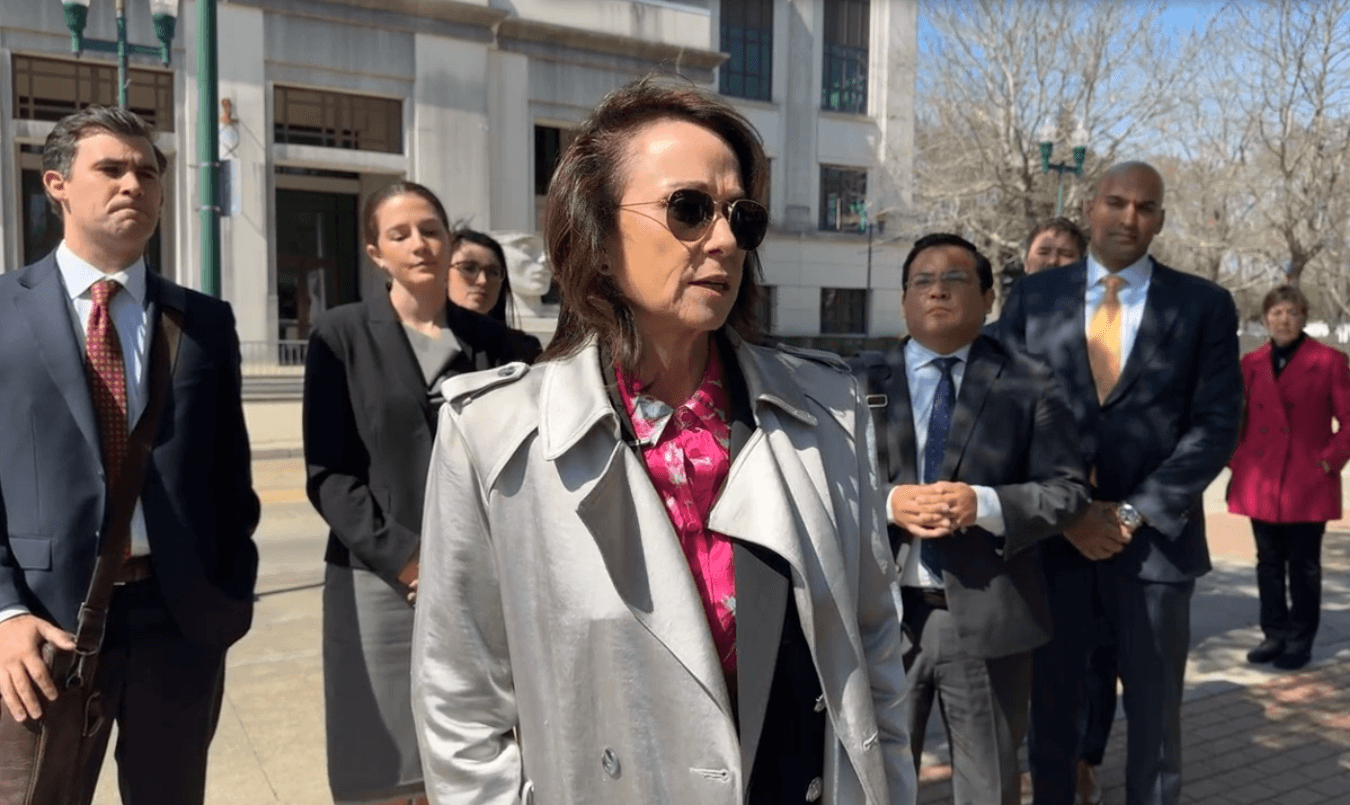
The State of Louisiana asked a federal court to block a Biden administration rule loosening one of the safety standards for chemical abortion pill mifepristone Tuesday.
The Feb. 24 hearing in the U.S. District Court for the Western District of Louisiana concerns the permanent removal of the in-person dispensing requirement for mifepristone in 2023 by the Biden FDA, which critics say opened the door wider for coerced abortion and chemical abortion pills to be unlawfully trafficked into states where they are banned.
“We’ve just come out of federal court where we were in a hearing asking Judge David Joseph to issue a preliminary injunction against the FDA’s Biden administration-era rule that relieved manufacturers of abortion pills from having to require in-person dispensing by doctors,” said Louisiana Attorney General Liz Murrill.
“We think that that is a very dangerous action that has posed great risk to women and certainly to the babies that we’ve been trying to protect under our state laws in Louisiana,” Murrill said in a social media post after the hearing.
The FDA under the Trump administration petitioned the court Jan. 27 to pause the state’s lawsuit in State of Louisiana v. U.S. Food and Drug Administration while the FDA continues its long-awaited review of chemical abortion drug mifepristone safety standards.
Pro-life and pregnancy help advocates have continually pressed for the FDA to return common sense safety regulations for mifepristone, which, among other things, included an initial in-person doctor visit to rule out ectopic pregnancy and other serious conditions, and a follow-up visit to check for life-threatening complications, such as internal bleeding and infection.
[Click here to subscribe to Pregnancy Help News!]
The FDA further lessened its REMS requirements for chemical abortion drugs, permitting them to be dispensed by pharmacies and delivered via mail. The Biden administration made access to the drug without in-person dispensing permanent in 2023.
The FDA’s REMS, or Risk Evaluation and Mitigation Strategies, is a drug safety program that the U.S. Food and Drug Administration can require for "certain medications with serious safety concerns to help ensure the benefits of the medication outweigh its risks,” according to the FDA.
Mifepristone has a REMS classification, one of some 73 drugs with such classification, a small percentage of the thousands of prescription medications approved by the FDA. Mifepristone also carries an FDA Black Box Warning, the highest level of safety warning.
The State of Louisiana and Rosalie Markezich, a Louisiana woman, are suing the FDA over the 2023 REMS.
Markezich, represented by legal non-profit Alliance Defending Freedom (ADF), was coerced to take abortion drugs by her boyfriend, ending the life of her unborn child. Her boyfriend obtained the drugs from a doctor in California.
"In today’s hearing in Louisiana, we urged the court to immediately halt the Biden FDA's unlawful mail-order abortion scheme and reject the federal government’s blatant attempt to stall this case,” ADF Senior Counsel and Director of the Center for Life Erik Baptist said in a statement provided to Pregnancy Help News.
“Since 2023, the FDA has deliberately pushed a mail-order abortion scheme designed to break Louisiana’s pro-life laws and nullify the will of its citizens,” Baptist said, “resulting in nearly 1,000 illegal abortions and 750 emergency room visits every single month.”
Tweet This: Since 2023, the FDA has pushed a mail-order abortion scheme designed to break Louisiana’s pro-life laws and nullify the will of its citizens
Louisiana and ADF argue that allowing mail-order abortion drugs circumvents the Supreme Court Dobbs decision putting abortion regulation back to the states and undercuts the right of those states to decide abortion law.
The State of Louisiana prohibits abortion in most cases, and abortion drug mifepristone and the accompanying misoprostol have been classified as controlled substances there since 2024.
“We have seen a dramatic uptick of abortions in our state because of these pills coming in through states like California and New York, who are intentionally trying to nullify our laws and that is being facilitated by the lack of a in-person dispensing requirement,” Murrill told reporters at a news conference.
“The evidence shows that it’s dangerous this is a drug with a Black Box Warning on it,” she said. “It causes hemorrhaging. It can cause sepsis. It can cause women to die.”
“We’ve seen women showing up in emergency rooms because of the way that these drugs are being mailed to them without any medical oversight whatsoever,
Murrill added. “It’s dangerous, it’s unethical, its illegal, and its immoral. And I think the FDA is continuing to facilitate that conduct by not reinstating the in-person dispensing requirement They should have done it a long time ago.”
Murrill said the Feb. 24 hearing was a “lengthy round” of arguments, the majority of the which centered on standing and the state’s ability to bring the lawsuit.
The arguments included input from chemical abortion drug manufacturers Danco and GenBioPro, whom Murrill said, “appear to be here solely to protect their profit margins.”
Heartbeat International, the largest network of pregnancy help organizations in both the U.S. and the world, was among 21 states, 60 members of Congress, and 58 pro-life organizations and advocates who filed friend-of-the-court briefs in the case.
Heartbeat argued in its brief that the FDA’s 2023 REMS “lowered the standard of care for treating a pregnant mother, placing her health at greater risk” and asked the court to reinstate the in-person dispensing requirement for mifepristone.
Murrill said a decision on the motion for preliminary injunction is expected in one to two months.
“We look forward to hearing from the judge on what the outcome will be on our request, she said. “But regardless of what happens here today we’re going to fight for women and the unborn in our state.”
Editor's note: Heartbeat International manages Pregnancy Help News.