


Judges consider that prayers or expressions of opinion cannot automatically be regarded as an attack on women seeking to terminate their pregnancies.
(Evangelical Focus) In recent years, many European countries have introduced measures to prevent women seeking abortions from encountering people who might try to dissuade them from going ahead with the procedure.
A well-known example is the law in the United Kingdom, where pro-life and civil rights groups have repeatedly criticised the creation of “buffer zones” around abortion clinics. Christians have been reported to the police and fined simply for praying in silence near one of these clinics.
Governments of various political persuasions have restricted public space in similar situations.
However, in two Central European countries, judges have now lifted such bans.
[Click here to subscribe to Pregnancy Help News!]
Ban lifted in Germany
According to Pro Medien Magazin and Livenet.ch, in 2024 the government of North Rhine-Westphalia banned a pro-life group from coming within 100 metres of abortion clinics. They cited the German Pregnancy Conflict Act, which in Section 13 “prohibits vigils if pregnant women are ‘harassed or intimidated’”.
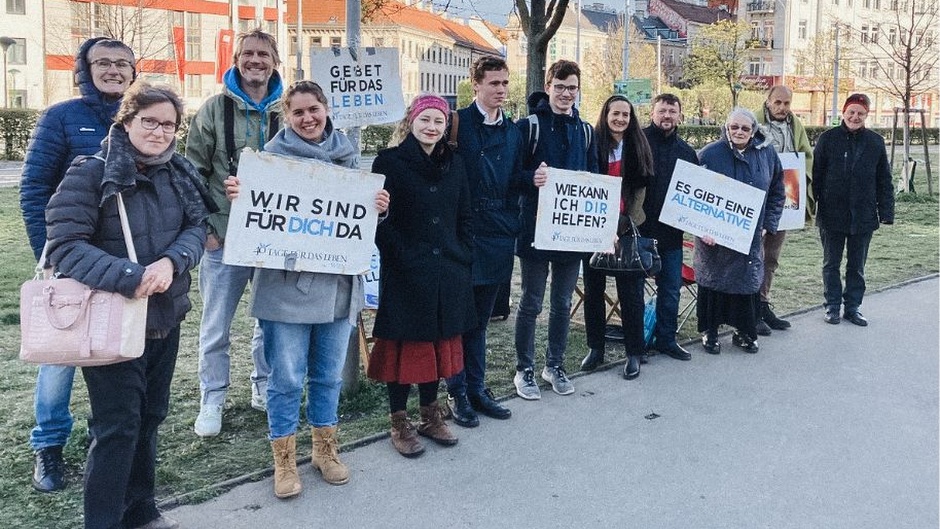
A court in Aachen, however, has concluded that the state government misapplied the law, because the pro-life group, which has been promoting alternatives to abortion for 20 years, merely displayed images of Jesus or children, but at no point interacted with the women or approached them directly. The law, the court states, neither “generally prohibits the expression of opinion nor the confrontation of pregnant women with the opinions of those attending the gathering”.
Vienna court says public prayers allowed
A similar decision was recently taken by an administrative court in Vienna, the capital of Austria. The group Jugend Fürs Leben (Youth For Life) announced its intention to hold “silent, peaceful prayer for the protection, dignity and preservation of human life” near abortion clinics, an action which was reported to the police, banned by them, though ultimately authorised.
The judges have now made it clear that peaceful prayer constitutes an assembly protected by the constitution and that expressions of this kind must not be banned in future.
The Austrian parliament is debating new legislation on street harassment in 2026, which could pose new obstacles for pro-life groups. However, any public expression or prayer gathering that does not initiate an unwanted conversation with a woman seeking an abortion could hardly be banned in the context of freedom of expression and assembly enshrined in the constitutions of most European countries.
Tweet This: Judges in two central European countries have lifted bans on pro-life outreach in proximity to abortion centers.
Attacks in Europe
Pro-life organisations have regularly come under attack from radical groups, particularly during the annual pro-life marches. In Portugal, in March 2026, an individual identified by the police threw a Molotov cocktail at the peaceful March For Life, though it did not cause any harm.
In Switzerland, violent anarchist groups have attempted to disrupt the annual pro-life festival and have clashed with riot police on several occasions.
Countries across the European continent have been liberalising their abortion laws. The latest case is that of England, where ‘home’ abortions will no longer be prosecuted, even if they take place after the time limit permitted by law.
Editor's note: This article was published by Evangelical Focus and is reprinted with permission.